Coste Tree Service gets Tallahassee and Leon County trees ready before hurricane season, not after. Proper structural pruning before the wind arrives is the cheapest storm insurance you can buy: it removes the deadwood, weak limbs, and dense canopy that turn a healthy tree into a hazard when a tropical system spins up. The work is done well before June 1, so your trees have time to recover before they take their first real wind.
Trimming is not the same as topping, and the difference matters more here than almost anywhere. Done right, storm prep makes a tree safer. Done wrong, it makes the tree more dangerous. We only do it the right way.
Storm prep pruning reduces the two things that bring trees down in a hurricane: dead or weak wood that snaps, and a dense canopy that catches wind like a sail. Done correctly, it lowers the odds of failure without harming the tree.
What it does not do is strip the tree. Over-thinning, called lion’s tailing, moves all the weight to the branch tips and makes limbs more likely to break, not less. Proper storm prep is subtle. If your tree looks dramatically different, too much came off.
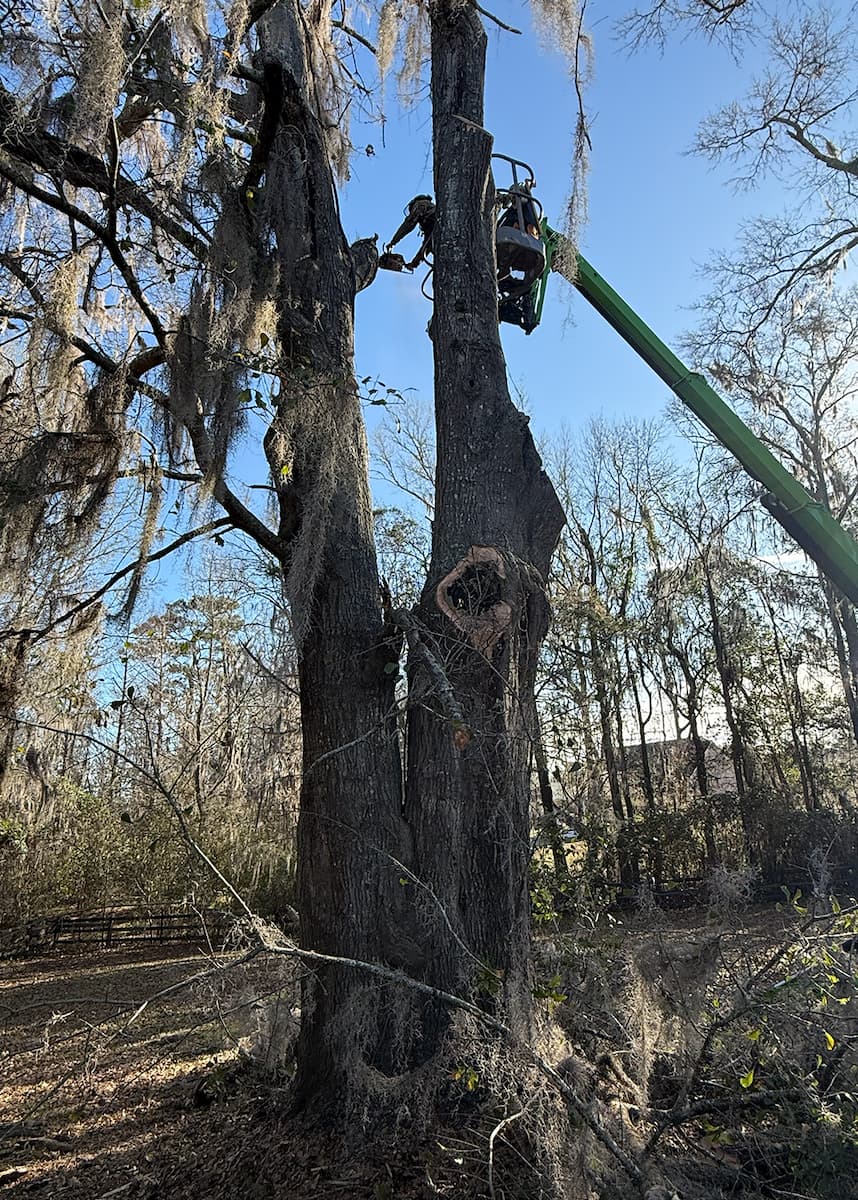
Not every tree is a storm risk, and we will tell you which of yours are. In the Big Bend, these are the ones that most often need attention before the season.
Tree or condition | Why it matters in a storm |
|---|---|
Water oak and laurel oak | Decay internally while looking healthy, then drop large limbs or fail |
Loblolly and slash pine | Snap under wind load and shed heavy limbs |
Any tree leaning over a roof or drive | A target zone if it fails, worth reducing or removing early |
Deadwood in a mature canopy | Dead limbs are the first to come down in high wind |
Dense, unthinned canopies | Catch wind like a sail and stress the whole tree |
Trees near your power drop | Failure here means damage plus a power outage |
Trees not pruned in 5+ years | Overdue for cleaning and structural correction before a storm |
The rule of thumb: if a tree is large, overdue for pruning, or leaning toward something you care about, it is worth a look before hurricane season, not after.
Before June 1, and ideally well before. Florida’s hurricane season runs June 1 through November 30, and pruning wounds need time to seal before a tree takes serious wind. Trimming heavily in late summer leaves fresh open wounds at exactly the wrong moment.
Two things worth knowing:
If a storm is already in the forecast, it is too late to prune safely and too dangerous to have a crew in your canopy. At that point the job shifts from prevention to emergency response. For a tree that is already failing, see our Emergency Tree Services page.
Get your trees assessed and pruned before the first system forms. Free on-site estimate, honest recommendations, no upsells.
Done ahead of time, pruning is a fraction of what emergency work costs, and it prevents the damage in the first place.
Storm prep is the opposite of the hurricane cut you may have seen done to palms and oaks. Stripping a tree does not protect it. Thoughtful pruning does.
Palms get their own rules, and the most common storm advice about them is wrong. The hurricane cut, where a palm is stripped to a few upright fronds, actually makes it more likely to lose its crown in a storm, and it can starve the palm. Remove only fully brown fronds and leave the rounded canopy intact. That is healthier and more storm-resistant. For full details, see our Tree Trimming and Pruning page.
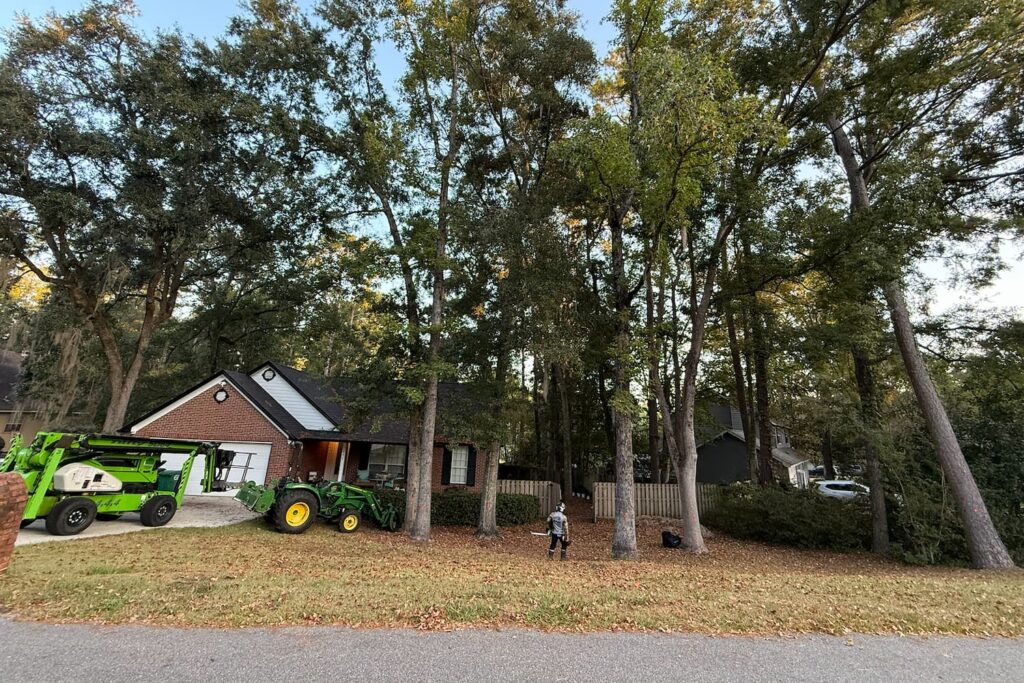
Coste Tree Service provides hurricane prep tree trimming throughout Tallahassee and Leon County, including Midtown, Killearn Estates, Bradfordville, Betton Hills, Myers Park, Lafayette Park, Ox Bottom, Bannerman Crossings, Southwood, and the canopy road corridors along Miccosukee, Centerville, Old Bainbridge, Meridian, and Old St. Augustine.
Before June 1, and ideally in late winter or spring so pruning wounds have time to seal before the tree takes wind. Deadwood and clearly hazardous limbs can be removed any time of year.
Correct pruning helps, by removing deadwood, correcting weak limb unions, and thinning a dense canopy so wind passes through. Topping does the opposite and makes a tree more dangerous. The difference is the whole point.
Yes, for safe pruning. Once a system is in the forecast it is unsafe to put a crew in your canopy, and fresh cuts have no time to recover. If a tree is already a hazard at that point, it becomes an emergency call.
No. We never top trees. Topping triggers weak regrowth and leaves a tree more likely to fail. We use proper thinning and reduction that make a tree genuinely more storm-resistant.
No. Stripping a palm to a few fronds, the hurricane cut, makes it more likely to lose its crown and can starve it. Remove only fully brown fronds and keep the canopy full.
Routine pruning generally does not require a permit, but heavy reduction on a protected tree or work in a canopy road corridor can. We check before we cut and confirm current rules with the city.
We tell you whether it needs to come down, and what it costs, in writing.
Coste Tree Service gets Tallahassee and Leon County trees ready before hurricane season, not after. Proper structural pruning before the wind arrives is the cheapest storm insurance you can buy: it removes the deadwood, weak limbs, and dense canopy that turn a healthy tree into a hazard when a tropical system spins up. The work is done well before June 1, so your trees have time to recover before they take their first real wind.
Trimming is not the same as topping, and the difference matters more here than almost anywhere. Done right, storm prep makes a tree safer. Done wrong, it makes the tree more dangerous. We only do it the right way.
Storm prep pruning reduces the two things that bring trees down in a hurricane: dead or weak wood that snaps, and a dense canopy that catches wind like a sail. Done correctly, it lowers the odds of failure without harming the tree.
What it does not do is strip the tree. Over-thinning, called lion’s tailing, moves all the weight to the branch tips and makes limbs more likely to break, not less. Proper storm prep is subtle. If your tree looks dramatically different, too much came off.
Not every tree is a storm risk, and we will tell you which of yours are. In the Big Bend, these are the ones that most often need attention before the season.
Tree or condition | Why it matters in a storm |
|---|---|
Water oak and laurel oak | Decay internally while looking healthy, then drop large limbs or fail |
Loblolly and slash pine | Snap under wind load and shed heavy limbs |
Any tree leaning over a roof or drive | A target zone if it fails, worth reducing or removing early |
Deadwood in a mature canopy | Dead limbs are the first to come down in high wind |
Dense, unthinned canopies | Catch wind like a sail and stress the whole tree |
Trees near your power drop | Failure here means damage plus a power outage |
Trees not pruned in 5+ years | Overdue for cleaning and structural correction before a storm |
The rule of thumb: if a tree is large, overdue for pruning, or leaning toward something you care about, it is worth a look before hurricane season, not after.
Before June 1, and ideally well before. Florida’s hurricane season runs June 1 through November 30, and pruning wounds need time to seal before a tree takes serious wind. Trimming heavily in late summer leaves fresh open wounds at exactly the wrong moment.
Two things worth knowing:
If a storm is already in the forecast, it is too late to prune safely and too dangerous to have a crew in your canopy. At that point the job shifts from prevention to emergency response. For a tree that is already failing, see our Emergency Tree Services page.
Get your trees assessed and pruned before the first system forms. Free on-site estimate, honest recommendations, no upsells.
Done ahead of time, pruning is a fraction of what emergency work costs, and it prevents the damage in the first place.
Storm prep is the opposite of the hurricane cut you may have seen done to palms and oaks. Stripping a tree does not protect it. Thoughtful pruning does.
Palms get their own rules, and the most common storm advice about them is wrong. The hurricane cut, where a palm is stripped to a few upright fronds, actually makes it more likely to lose its crown in a storm, and it can starve the palm. Remove only fully brown fronds and leave the rounded canopy intact. That is healthier and more storm-resistant. For full details, see our Tree Trimming and Pruning page.
Coste Tree Service provides hurricane prep tree trimming throughout Tallahassee and Leon County, including Midtown, Killearn Estates, Bradfordville, Betton Hills, Myers Park, Lafayette Park, Ox Bottom, Bannerman Crossings, Southwood, and the canopy road corridors along Miccosukee, Centerville, Old Bainbridge, Meridian, and Old St. Augustine.
Before June 1, and ideally in late winter or spring so pruning wounds have time to seal before the tree takes wind. Deadwood and clearly hazardous limbs can be removed any time of year.
Correct pruning helps, by removing deadwood, correcting weak limb unions, and thinning a dense canopy so wind passes through. Topping does the opposite and makes a tree more dangerous. The difference is the whole point.
Yes, for safe pruning. Once a system is in the forecast it is unsafe to put a crew in your canopy, and fresh cuts have no time to recover. If a tree is already a hazard at that point, it becomes an emergency call.
No. We never top trees. Topping triggers weak regrowth and leaves a tree more likely to fail. We use proper thinning and reduction that make a tree genuinely more storm-resistant.
No. Stripping a palm to a few fronds, the hurricane cut, makes it more likely to lose its crown and can starve it. Remove only fully brown fronds and keep the canopy full.
Routine pruning generally does not require a permit, but heavy reduction on a protected tree or work in a canopy road corridor can. We check before we cut and confirm current rules with the city.
We tell you whether it needs to come down, and what it costs, in writing.
Tell us what you need and we’ll call you back within one business day.
I couldn’t recommend Coste Tree Service more highly! Jason Coste and his team are professional, reliable, and incredibly knowledgeable. From the first call to the final cleanup, the entire process was seamless. They showed up on time, took great care in their work, and left the property looking better than ever.