How Much Does Tree Removal Cost in Tallahassee? (2026)
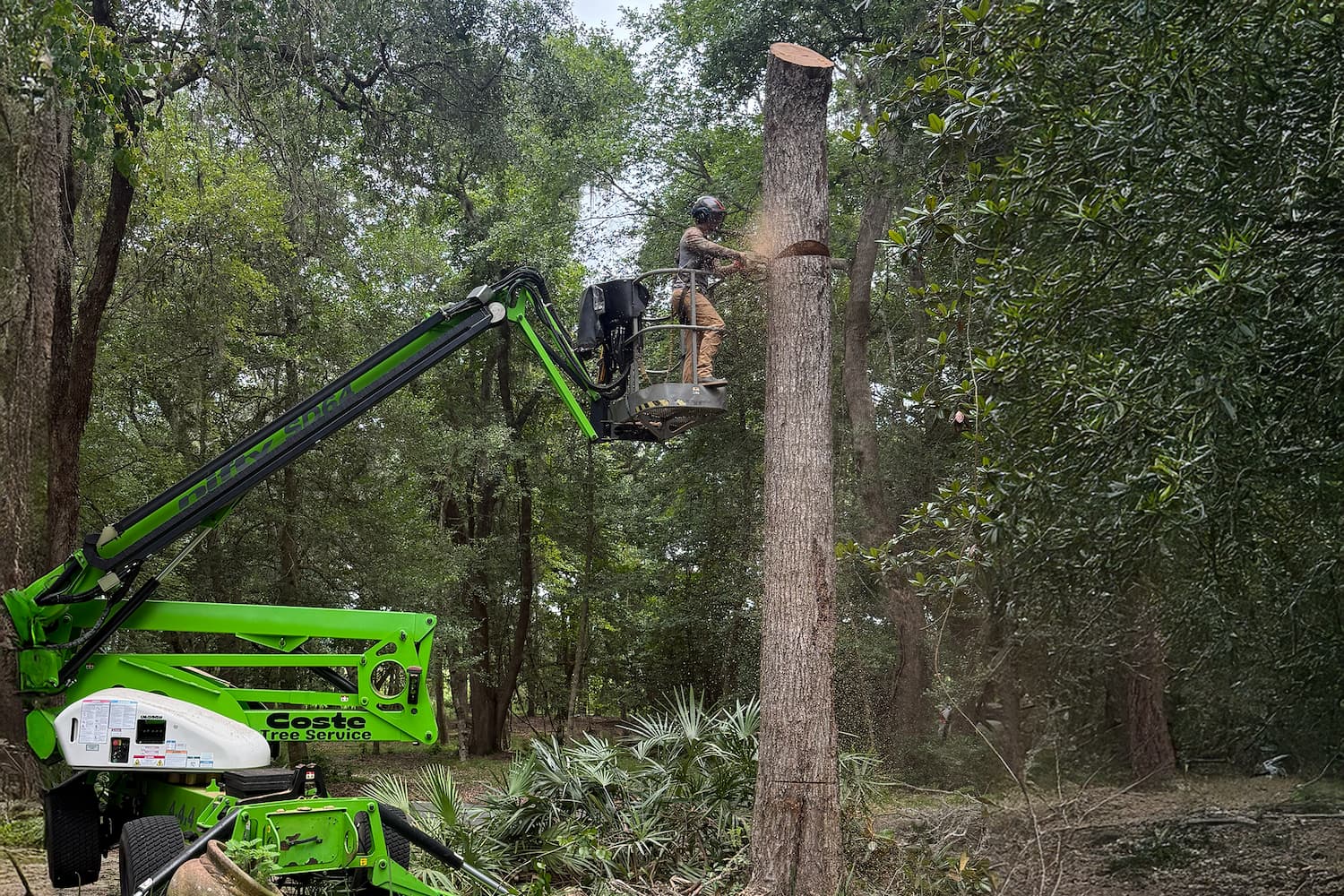
Most tree removals in the Tallahassee area run between $400 and $1,800 in 2026, but that range is wide because the price depends almost entirely on the specific tree: its size, its species, and how close it is to your house or the power lines. A small crape myrtle in an open yard and an 80-foot live oak leaning over your roof are very different jobs.
This guide breaks down real 2026 tree removal costs by size, what trimming and stump grinding add, the factors that move your quote, and the Florida permit rules that recently changed and that most homeowners still get wrong.
Tree removal in the Tallahassee area typically costs $400 to $1,800 per tree in 2026, with an average around $900. Small trees run $200 to $500, medium trees $600 to $1,200, and large trees $1,200 to $3,000 or more. Size, species, and proximity to structures are the biggest cost factors.
Key Takeaways
- Size is the biggest factor. Expect roughly $200 to $500 for small trees, $600 to $1,200 for medium, and $1,200 to $3,000+ for large trees.
- Stump grinding is usually separate, commonly $2 to $5 per diameter inch with a minimum around $100 to $150.
- Trimming costs less than removal, generally $200 to $900 per tree depending on size.
- Access and hazards drive the price up. A tree over a house or near power lines costs far more than one in an open yard.
- Florida law changed in 2022. A permit is often not required to remove a genuinely hazardous tree from residential property, with the right documentation.
How Much Does Tree Removal Cost by Size?
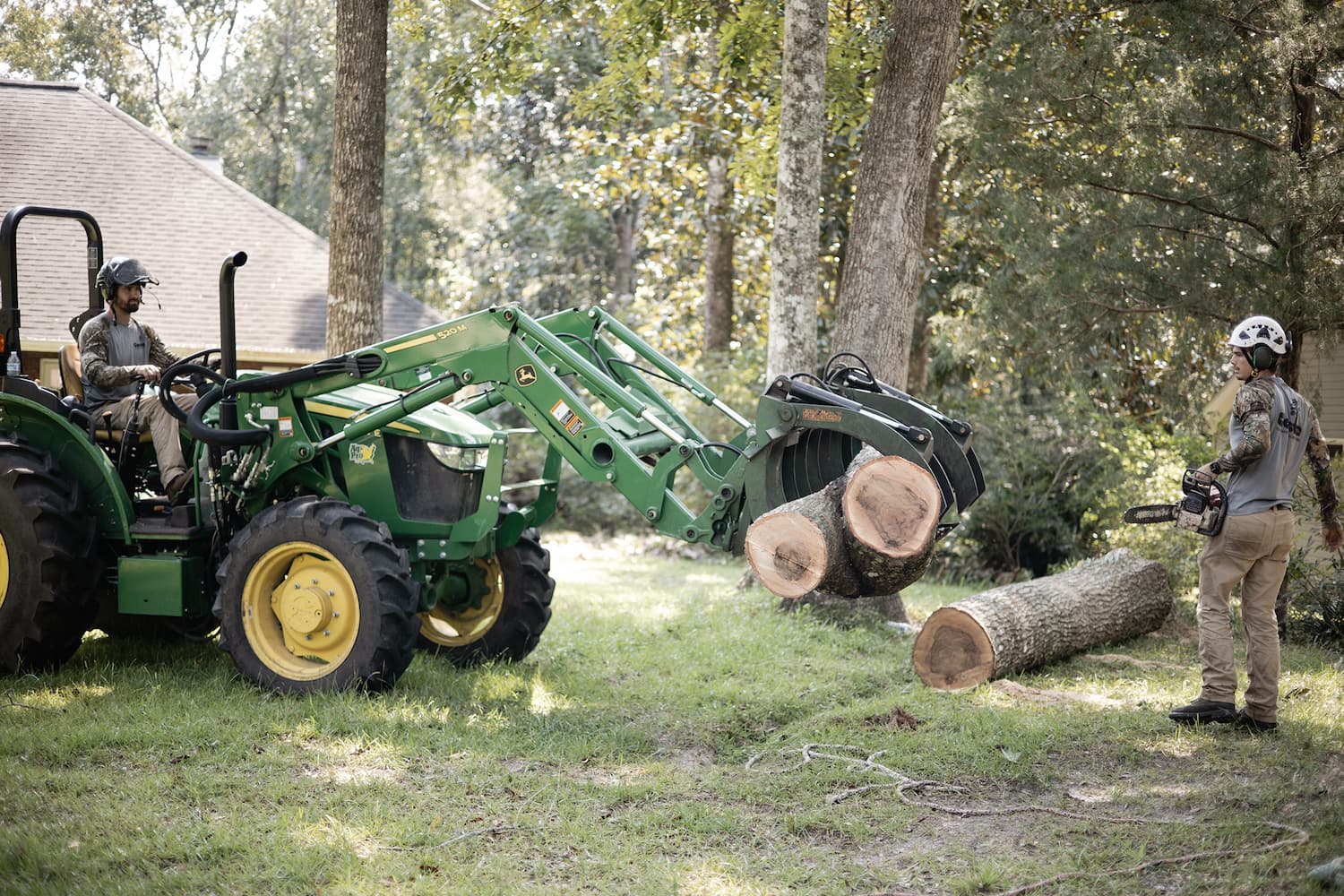
Tree removal cost is driven mostly by size. In 2026, small trees under 30 feet typically cost $200 to $500 to remove, medium trees from 30 to 60 feet run $600 to $1,200, and large trees over 60 feet cost $1,200 to $3,000 or more. Very large or hazardous trees can exceed these ranges.
Height is the starting point because it determines the equipment, crew, and time the job requires. Here are working 2026 ranges for the Tallahassee area. Treat these as planning figures, not quotes.
Tree size | Height | Typical removal cost | Examples |
|---|---|---|---|
Small | Under 30 ft | $200 to $500 | Crape myrtle, small palm, dogwood |
Medium | 30 to 60 ft | $600 to $1,200 | Young oak, pine, medium palm |
Large | 60 to 80 ft | $1,200 to $2,000 | Mature oak, tall pine |
Very large | Over 80 ft | $2,000 to $3,500+ | Grand live oak, large hardwood |
These ranges align with national 2026 data, which places most removals between $400 and $1,800 with an average near $900, and large or hazardous trees running considerably higher. In our area, mature live oaks and tall pines are the trees most likely to land at the upper end, because of their size and density and because they so often stand close to homes.
One structural cost note: species matters. Dense hardwoods like live oak take longer to cut and haul than softer pine of the same height, so a shorter, thicker hardwood can cost more than a taller pine.
What Does Stump Grinding Cost?
Stump grinding is almost always priced separately from tree removal. In 2026 it typically costs $2 to $5 per diameter inch of the stump, with most companies charging a minimum of around $100 to $150. A single average stump often runs $150 to $400, while large hardwood stumps can cost more.
It surprises many homeowners that removing the tree does not remove the stump. Grinding is a distinct job with its own equipment, so it appears as a separate line item.
How stump pricing works:
- Per-inch pricing. Most grinding is billed at roughly $2 to $5 per inch of stump diameter, measured across the widest point.
- Minimum charge. Expect a minimum around $100 to $150 even for a small stump, because the machine still has to be hauled out.
- Multiple stumps. The per-stump cost usually drops when several are done in one visit, sometimes to $40 to $75 each after the first.
- Grinding vs full removal. Grinding takes the stump 6 to 12 inches below grade and leaves the roots to decompose. Full root excavation costs more but removes everything.
Because grinding shares mobilization with the removal, bundling the stump into the same visit is almost always cheaper than scheduling it separately later.
How Much Does Tree Trimming Cost?
Tree trimming and pruning cost less than removal, typically $200 to $900 per tree in 2026, with a national average around $460. The price depends on the tree’s size, how much is being removed, and how difficult the tree is to access. Large or hard-to-reach trees sit at the higher end.
Trimming is a different service from removal, focused on the health, safety, and shape of a tree you are keeping. It is also usually a recurring need rather than a one-time job.
General trimming cost ranges:
- Small trees: roughly $150 to $450.
- Medium trees: roughly $450 to $700.
- Large trees: roughly $700 to $1,500 for tall or complex canopies.
For many Tallahassee homeowners, regular trimming is also a storm-preparedness measure. Thinning a dense canopy and removing dead or weak limbs before hurricane season reduces the chance of a limb failure that damages a roof, which is far cheaper than the emergency removal and repair that follows a storm.
What Factors Affect the Cost of Tree Removal?
Beyond size, the main cost factors are species and wood density, proximity to structures and power lines, tree health and stability, site access, and whether stump grinding or emergency service is needed. A hazardous tree over a house can cost several times more than a similar tree standing alone in an open yard.
Two trees of identical height can carry very different prices. Here is what moves the number.
- Proximity to structures. A tree that can be felled in one piece is cheap. A tree over a house, fence, or power line must be climbed and dismantled in sections with rigging, which takes far longer.
- Power lines. Trees near utility lines add serious complexity and risk, raising the cost.
- Tree health. A dead or unstable tree is more dangerous to remove, since brittle wood behaves unpredictably, which can increase the price.
- Access. A backyard tree behind a narrow gate, with no room for equipment, costs more than one a truck can pull right up to.
- Species and density. Dense hardwoods take longer to cut and generate more, heavier debris to haul.
- Emergency and storm work. Urgent removals after a storm, especially trees on structures, command premium pricing due to risk and scheduling.
This is also why an accurate quote requires seeing the tree. A price given sight-unseen cannot account for the access, lean, and proximity issues that determine the real cost.
Do You Need a Permit to Remove a Tree in Florida?
Often not, for residential property. A 2022 Florida law lets homeowners remove a tree from residential property without a local permit if a certified arborist or licensed landscape architect documents that the tree poses an unacceptable risk. Trees that are not hazardous, and non-residential properties, may still require local approval.
This is the single most misunderstood part of Florida tree removal, and it changed relatively recently, so it is worth getting right.
Under Florida Statute 163.045, amended by Senate Bill 518 effective July 1, 2022, a local government may not require a notice, application, approval, permit, fee, or mitigation to prune, trim, or remove a tree on residential property when the owner has documentation from an arborist certified by the International Society of Arboriculture (ISA) or a Florida licensed landscape architect establishing that the tree poses an unacceptable risk. The law defines an unacceptable risk using the standards in the Best Management Practices for Tree Risk Assessment.
The key limits to understand:
- It applies to residential property, specifically single-family detached homes as defined in the statute.
- It requires proper documentation from a certified arborist or licensed landscape architect. Without it, the exemption does not apply.
- The tree must genuinely pose an unacceptable risk. A healthy tree you simply want gone is not automatically covered.
- Local rules still exist for non-hazardous trees, commercial and multi-family property, and land clearing for development.
Because the documentation must come from a certified professional, working with a qualified tree service that includes or coordinates ISA-certified assessment keeps you on the right side of the law. When in doubt, confirm current requirements with your local government, since interpretation can vary by jurisdiction.
How Can You Save Money on Tree Work?
You can lower tree service costs by bundling removal and stump grinding into one visit, scheduling non-urgent work outside of storm season, addressing problem trees before they become emergencies, and getting multiple written quotes. Preventive trimming is also cheaper than the emergency removal a neglected tree eventually requires.
Smart timing and planning genuinely reduce what you pay. Practical ways to save:
- Bundle services. Combine removal, stump grinding, and hauling in one visit to share the mobilization cost.
- Avoid emergency pricing. Address a declining or leaning tree on a normal schedule rather than paying premium rates after it fails in a storm.
- Do several trees at once. Crews often reduce the per-tree rate when handling multiple trees on the same visit.
- Trim preventively. Regular pruning extends tree life and prevents the failures that lead to expensive removals and property damage.
- Get written quotes. Compare at least a few licensed, insured providers on scope, not just price.
The most expensive tree is almost always the one you ignore until it becomes an emergency. Proactive care is the real cost control.
Get a Tree Removal Estimate From Coste Tree Service
Every tree is different, and the only way to get an accurate price is to have someone look at it: its size, species, lean, health, and how close it stands to your home and the lines. A walked estimate turns a wide range into a real number you can plan around.
Coste Tree Service works with homeowners across the Tallahassee and Big Bend area to provide tree removal, trimming, stump grinding, and storm response, with honest, on-site estimates.
To get started, contact Coste Tree Service for a free tree removal estimate. A specialist will assess your trees, explain your options, and provide a written quote for the work.
Frequently Asked Questions
Most tree removals run $400 to $1,800 in 2026, averaging around $900. Small trees under 30 feet typically cost $200 to $500, medium trees $600 to $1,200, and large trees over 60 feet $1,200 to $3,000 or more. Size, species, and proximity to structures drive the final price.
Usually not. Stump grinding is typically a separate charge, commonly $2 to $5 per diameter inch with a minimum around $100 to $150. Bundling it into the same visit as the removal is almost always cheaper than scheduling it separately, since it shares the equipment mobilization cost.
Yes. Trimming or pruning generally costs $200 to $900 per tree, less than a full removal, and it is often a recurring service. Regular trimming also serves as storm preparation, reducing the risk of limb failures that damage property and lead to far more expensive emergency removals.
Often not, for residential property. A 2022 state law lets homeowners remove a hazardous tree without a local permit if a certified arborist or licensed landscape architect documents that it poses an unacceptable risk. Non-hazardous trees and non-residential properties may still require local approval, so confirm with your jurisdiction.
An accurate quote depends on details that cannot be seen remotely: the tree's exact size, lean, health, species, access for equipment, and proximity to structures and power lines. These factors can multiply the cost, so a reputable company assesses the tree in person before providing a written estimate.
Why Coste Tree
- Same day estimates on storm damage
- Permit filing handled for protected trees
- Sectional rigging near roofs and lines
- Site raked clean before we leave
Free On Site Tree Assessment
We tell you whether it needs to come down, and what it costs, in writing.